Thursday, 9 July 2015

Nothing (much) to do with cycling: “Greece is the Word, the Word..”


A few years ago, I took the family for an October half-term holiday to a Mark Warner resort near Kalamata, in Greece.  We had been spending this week for some years at Sunsail resorts in Turkey, until, for reasons too complex to go into here, their entire Aegean operation folded, and we were left looking at late notice for a Plan B and at this stage we had not yet discovered Neilson.

The proposition is similar across several operators including Warner, Sunsail, Neilson, Club Med etc.  A hotel and beach complex offering pool, spa, pilates etc plus dinghy sailing and windsurfing, with RYA-certified courses and instructors, and tennis, with a team of coaches.  Mark Warner is heavier on the tennis than most, with about a dozen courts in their Kalamata resort.  But (and I’ll return to this later) no mountain biking, normally a significant part of the mix in these resorts. (Actually, what they mean is a 50/50 mix of on and offroad riding, using upper midmarket Hardtail XC bikes by Specialized or Gary Fisher).

Anyway, back to Kalamata.  With capacity for about 500 guests, the resort witnesses the Home Counties professional middle classes wandering about in their tennis whites, enjoying a drink at the bar between matches and coaching sessions.  You have everything you (apparently) need right there.

Your chances of meeting a Greek though are pretty small.  The hotel manager was local, and quite possibly the housekeeping staff were too, although they kept themselves largely invisible.  All the beach staff, the instructors and the tennis coaches, were British.  The bar, restaurant and kitchen were staffed by Poles and Balts.

And you were not very likely to meet Greeks outside the resort either.  There were no organised trips to sites of local interest (Kalamata, as a city, is actually not very interesting, despite being the home of the eponymous olive) and barely any information either, just a few typewritten notes and photos in a folder at reception about Pilos, a small port town to the west – a local bus service every hour, with the stop at the top of the service road about a mile from the resort entrance – walk there yourself.

And, curiously for such resorts, no bicycles.  Not merely no MTBs for guests, and no guided tours.  Knowing this in advance I packed my Birdie (full-suspension folder) in its carrying bag and, after a tense discussion at the charter operator’s check-in at Gatwirck, checked it in as hold baggage.  I tracked down a 1:100,000 road map of the area, photocopied the relevant pages, and made annotations from a careful study of Google Earth photography.  Thus equipped I was able to tour widely around the resort on roads and tracks, coming across the occasional ford not detectable on map or Google and giving my Birdie a much-needed though unplanned wash, and visit the local small towns and villages.

A few intrepid guests solved the dilemma by going into nearby Messina and hiring a curious motley of roadster bicycles, but otherwise I suspect 475 out of 500 guests never ventured past the resort gates all week.

Now, how much was any of this doing for yer average Greek?  Not much, it would seem.  I don’t know whether locals were too snooty to work in tourism, or were simply undercut by eastern European migrants and British Gap Yah types willing to work for beer money, a roof over their heads and as much sun and sex as they could lay hands on.  The hotel owner was probably a corporation or a wealthy individual whose wealth and profits were quite likely being spirited out of the country to avoid tax, while local people didn’t appear to be making any money on which to evade tax. 

Contrast this with Neilson on the Turkish Aegean coast where, through Turkish labour policy and what I suspect was a more socially-responsible corporate policy, all housekeeping, catering and bar staff were locals, together with a fair proportion of the sailing and waterski instructors and the mountain bike guides – many of whom were brought to the UK in the off season to freeze their butts off in the Solent undergoing instructor training courses.  There my money really was going partly into the local economy, and that made me feel better.

The problems faced today by Greece are many and complex.  Go back far enough, and there is the wartime occupation and the plundering by the Nazis of Greece’s treasures, for which only fairly minimal compensation was ever paid.  The Euro can’t have helped, denying as it did the latitude to devalue the exchange rate to protect Greek exports from “unfair” price competition and put up barriers to the more frivolous imports.  I think it has long been suspected that much of the government borrowing went ultimately to line the pockets of politicians and their cronies.  And the major investment banks have been shamefully let off the hook when the IMF, unusually, insisted that the consolidation of Greek government debt into the NGO lenders should fully repay the private banks, at least one of which to my certain knowledge actively marketed complex derivatives which they promised would serve, Enron-style, to disguise the related borrowings from the national balance sheet.

Whatever.  The one person you can confidently say is not responsible for this mess, but is being made to pay the price, is Iannis, or Androulla, Publikos.

Wednesday, 10 June 2015

Feedback loop


Why do so many cyclists have to look like a character from “The Roswell Incident”?

This morning on my way into work, astride my Brompton, dressed in  a cotton long-sleeve business shirt and navy blue cotton chinos, I come up at the lights behind a guy on a carbon (I guess) road bike with skinny tyres, derailleur gears and treadless skinny rims.  His attire comprised cleated shoes, lycra shorts and jersey, helmet and shades, topped off with a natty Rapha rucsac.

All for the journey into work.  At least I guess that was his plan – he wasn’t practising for Le Tour de France.

I think this was a fairly extreme case, but it is a commonplace that London cyclists ride derailleur-geared bikes – when hub gears are far more practical for stop-start at lights and junctions – without mudguards or panniers, and they wear broadly sporty clothing, shorts and tees even in cold weather.

But, isn’t that just part of a vicious circle, a feedback loop?  People ride in what is comfortable for the style of riding they want to adopt, and on machines which they consider, on balance, to be more efficient for the style of riding they want to adopt.  That style is VC – behave like a motor vehicle, occupy the road and keep up with the traffic.  Because that is what makes them feel safe and tolerably comfortable in the traffic conditions.

It also reinforces their alien quality, their otherness, which validates in the minds of non-cyclists their dislike and distrust of them.  It excuses politicians and engineers for disregarding the interests of cyclists, allocating virtually no money to their needs despite the fact that they pay quite substantially towards the roads (as all taxpayers do – “road tax” is pitifully inadequate to cover the true cost of roads) and then taking back even what they have allocated.  The result is no or insufficient good cycle infrastructure which would otherwise bring ordinary people in ordinary clothes on ordinary utility bicycles out of hiding, leaving the roads still dominated by “Small Grey”, and so the cycle continues.

Only two days ago, I was passing the works on a section of the new East-West superhighway on the Embankment in front of the Whitehall government buildings and Portcullis House – in a taxi, as I maintain you might not need to be mad to cycle there, but it certainly helps – and I could see that a fairly respectable width of track was being created behind a clearly defined line of kerbstones.  It is good to see that this is actually happening.  Let’s hope that when it is finished, it sees lots of new cyclists riding those ordinary bikes in those ordinary clothes, at a sedate jogging pace with occasional stops to respect the traffic lights imposed on the route.  With that perhaps we will see firstly the irrefutable empirical proof that infrastructure is good both for cycling and for all other modes of transport, and secondly an appreciation from the general public that “cyclists” are just people, trying to go about their normal business, only on a bicycle.

Thursday, 28 May 2015

A Senior Moment


So, BikeHub reports on research conducted by the University ofWestern England into why “seniors” do so little cycling in the UK, compared with Denmark or the Netherlands.

I could have told them.

I “celebrated” (if that is the right word) my 60th last week.  Tomorrow is my last day as a full-time worker – from next week I give up my position as a partner in an accounting firm and I start a part-time consultancy with them for a year or two.  I have already collected my “Senior Railcard” – which I will need to make my commuting bill manageable as South West Trains makes no provision for part-timer season tickets and has no apparent intention of doing so in the foreseeable future.

I digress.  My commute to work is a sandwich, two short cycle trips as the bread with a 50 minute train ride as the meat.  The bottom slice is a peaceful saunter down a country lane, through the station car park and a hundred metres or so of busy road to the station entrance.  The top slice is from Waterloo to Blackfriars, over Blackfriars Bridge.

I hope that I will still be working and commuting this route when the new North-South Cycle Superhighway, whose construction has now started, is complete and could take me from Stamford Street to a point barely 100 metres from my office, where Farringdon St meets St Bride St.  By then I think I am going to need it.

Why?  Firstly, anyone over 40 will know that your faculties begin to decline with age.  My one-time 20/20 vision has now deteriorated to eth point where I have to increase my reading specs prescription every 2-3 years.  I am not quite at the point of needing specs for driving, but I can’t be far off.  More to the point, my strength, stamina and flexibility are all declining, and I have to work ever harder in the gym to slow the rate of decline.  I am now overtaken by more often than I overtake other cyclists.  I am finding it ever harder to achieve the sprint speeds and rapid acceleration which John Franklin calls for in his book to be a vehicular cyclist – a term I deplore although I readily acknowledge that VC is the only real strategy for staying safe on busy roads.  I have mild osteo-arthritis in my left knee and I know there is only one way that can go – downhill.

Secondly, I am losing my confidence.  I am becoming more anxious and more fearful.  That seems to be a common feature of ageing.  Older people’s fears – of strangers, youth, immigrants, anyone who is somehow “different” from themselves, may not be laudable but I can understand it as I experience more anxiety about other things which really don’t matter like whether I forgot to put my phone on charge. In cycling terms, I am becoming more anxious and less confident about the behaviour of people around me.  Not only motorists but occasionally other cyclists – I have been unbalanced by close-passes to my right, and experience an increasing number of close-passes to my left which, if they unbalanced me, could tip me into the path of something much heavier and faster and more lethal.  I view most motorists these days with suspicion, even if that great majority of them are actually not hell-bent on killing me.

But there is one thing about which my anxiety is entirely rational – fear of injury.  As you get older, you take longer to recover from injury or illness or the effects of an operation.  I have had four collisions with cars or taxis since I took up cycling in London, and the last of these, while really no more serious than the first three, which I shrugged off, left me in need of an operation on my shoulder which, 2 ½ years later, I have still not fully recovered from – in most respects I get along but when my personal trainer makes me do a plank, it is not my core strength which fails me but my right upper arm and shoulder which buckle after about a minute.  Inability to recover from injury really frightens me, as I recall how a botched operation to repair her knee largely immobilised my mother and started her spiral of decline into eventual dementia and a care home.  (Thank the Lord that she is no longer around to suffer the steep spiral of decline we can expect in local authority adult social care – they were piss-poor five years ago, I shudder to think where they are going now).

So, I simply don’t see myself continuing to cycle in central London for much longer without segregated cycle provision. My travel by bike has already been curtailed to routes I know well, and where I can stay clear of the worst situations such as deliberately-narrowed busy streets like Cheapside, Strand, Pall Mall or Ken High Street.

So roll on the two segregated superhighways.  May they be only the first, as I am sure they will be, when live data hammers home the point beyond even the densest petrol-head minister’s capacity for self-denial, that they are a brilliant solution to any city’s transport problems and should be implemented wholesale.

Wednesday, 10 December 2014

Private Lives, Public Virtues


In its responses to the consultations on the East-West and North-South cycle superhighways which are due to meet at Blackfriars Bridge, the City of London cited two principal concerns.


The first of these, adverse implications for pedestrians in the City, I have commented on elsewhere.  In short, instead of focussing on the entirely new pedestrian crossings aligned parallel to the N-S route where it crosses Fleet St and Ludgate Hill (where currently pedestrians just have to chance their arm – or their leg –crossing without any form of pedestrian priority), or the restored crossing at the foot of New Bridge Street near the Black Friar pub (whose removal a few years ago elicited not even one squeak of protest from the City) or even the proposed entirely new crossing on the other bank of the Thames, at Stamford Street, where thousands of city workers walking from waterloo currently have to run the gauntlet of fast and heavy traffic without any form of priority or protection, The City instead quibbles about a 20 second increase in waiting time for pedestrians at one or two crossings.  If they really had their constituents’ interests at heart, don’t you think they would have attended to those other concerns before now?


The second is the suggestion that the space given over to the cycle paths and so, partly, taken from moving motor traffic will increase congestion and so journey times.  It is of course not the City’s fault that TfL has failed to provide any modelling data on what would happen to congestion and journey times as a result of transference of journeys from car/taxi to bicycle, or indeed to simple traffic evaporation (a well known consequence of reducing road capacity).  TfL has simply modelled as though traffic volumes do not change.


However, how sincere is the City’s concern about traffic congestion?  They must surely then be very opposed to anything which takes away road space from motor vehicles and so exacerbates congestion on their streets?  Don’t you think?


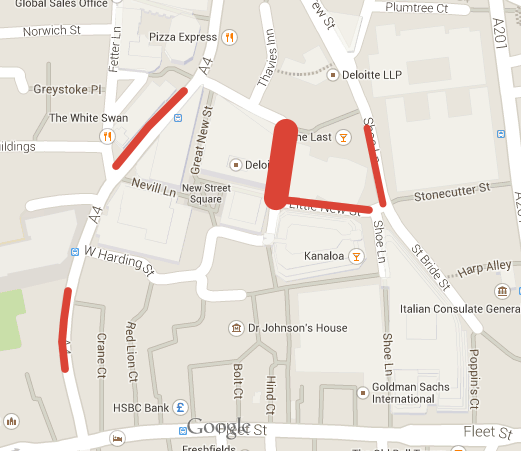
Take a look at this square of the City immediately around my office building, between Shoe Lane and Fetter Lane, Fleet Street and Holborn.


I have crudely drawn in red lines to indicate road space which has been expropriated, with the City’s consent, to the exclusive use of private property developers.


One short stretch has been closed across its entire width, leaving only the footway passable.  This stretch is being used as the loading/unloading area for materials entering or leaving the site of Land Securities’ new development at One New Street Square, the former site of the International Press Centre.  I suppose I should be grateful – rumours are afoot that this building, once completed, will be occupied by my firm, so allowing us to escape from the 70s multi-storey-car-park monstrosity we occupy today.


Forming a corner with this, half of the available width of Little New Street has been expropriated, also for Land Securities, to site their plant – generators and the like.


And just around the next corner, in Shoe Lane, another stretch of the road has been expropriated over half of its width, same reasons.


A stone’s throw away, in New Fetter Lane, there are two similar expropriations, each of about half the road width, adjacent to a new luxury apartment block nearing completion, and a little further north adjacent to the redevelopment of Number 20 New Fetter Lane.


What do all of these have I common?  They are private uses of public amenity land.  They extend the area on which a private developer can operate to build a privately owned development.  They therefore permit the developer to make more profits by permitting development of the entire footplate of the site and/or to facilitate construction operations there.


Now, I am not going to make a value judgement about whether there is public benefit to be gained from these private arrangements – for example more profits might mean more taxation on the developer and more square footage of development might mean higher business rates for the Exchequer – but I don’t think anyone, not even Canary Wharf, is denying the manifest public benefit of protected cycle paths into central London. 

So why are they so critical of the perceived congestion outcomes of the cycleways but apparently perfectly happy to accept similar implications from private developments?


Monday, 10 November 2014

Two tribes


People tend to discuss cyclists and motorists in a two-tribes fashion, as though they are somehow different breeds, with no connection with each other.

In terms of my travel habits, I am first and foremost a middle-distance commuter.  I travel some 18,000 miles a year on my daily train journeys to and from work.  That is considerably further than I travel by any other mode of transport.

I am a cyclist, primarily as part of my commute – I cycle from home to the railway station in Haslemere where I fold up my Brompton, carry it onto the train and then unfold it at Waterloo for the final leg of my journey to the office in Blackfriars.  However I also cycle Saturdays and Sundays down to the town centre for shopping.  I could drive, and sometimes I am tempted, if the weather is bad, but driving imposes additional hassle, in first hunting for a parking space, then walking over to the machine to get a ticket, fumbling for the right change, probably overpaying because I don’t have the right change, then walking back to the car to put the ticket in the windscreen.  By the time I have done all that I could be half-way through my shopping errands, because like most people these days we have abandoned the “weekly shop” at the big out-of-town supermarket (read this and weep, Tesco) and make almost daily visits and small purchases (which I am sure, as the research literature shows, amount to more than more occasional, car-borne shoppers).  So I save time, hassle and of course money – I even get a parking rebate in our local Waitrose as they just assume you must have driven there.  I do cycle purely for exercise or leisure, from time to time, though not as often as I really should if I want to stay healthy as retirement looms. I don’t really have any excuse as I live on the doorstep of a fantastic area of National Trust heaths and commons around Hindhead, Thursley, Witley, Hankley, Bramshott etc. with an extensive network of bridle paths.

I am a pedestrian.  Apart from walking the dogs at weekends, which I don’t really think of as “pedestrian”, more “walker” or “rambler”, most of my pedestrian activity is associated with work, in central London.  Popping out for lunch, a trip to Boots, walking to a tube station etc account for a modest daily mileage but certainly I'm exposed to the realities of being a pedestrian in a big city.

I use taxis and – whisper it – Addison Lee cars.  Being employed in a professional service firm I have a lot of meetings with clients across the city and, as we sell our services by the hour time is a precious commodity.  We need access to a mobile signal so we can continue working, and we travel together so we can discuss our plan for the meeting ahead, something we can’t do on a bus or tube. 

Finally, I drive.  Almost entirely in my free time, at weekends.  I live in a rural area and although I can make a number of my routine journeys – to my French tutor on Saturday, down to the sailing club in Portsmouth to sail my dinghy – by bike/train, there's a lot of trips which simply can only be done by car.  Taking my teenaged son to his Saturday job in the bakery section at Waitrose in Godalming, for a 6am start, or doing winter maintenance work on my boat when I will be carrying stepladders, buckets, power tools (those Kรคrcher pressure washers are really handy), spare parts etc in the boot of my car.  I guess I probably do about 5,000 miles a year behind the wheel, which is not a great deal more than I do in the saddle.

I can understand the frustrations felt by any of these “ists” when they meet delays and obstacles.  I get irritated by the delays, cancellations and overcrowding I experience from time to time on my rail commute.  I acknowledge that I can start to feel impatient if I am stuck behind an organised group of cyclists, even though at the same time I am pinching myself to remember that I, too am a cyclist, and that those guys out there (they are almost always guys) have every bit as much right to be there as I do, and have almost certainly paid similar amounts of vehicle excise duty and road fuel duty as I do.  They have probably also paid comparable amounts in council tax, and income tax and national insurance contributions too.  All of these together go into the common fund which pays for roads.

For all of this, I suppose I define myself as a cyclist, and I am probably pigeon-holed as such too, by people who are ignorant of, or care nothing for my alter-egos.

As a motorist, I am only too acutely aware that, with no malice and no wilful negligence, impatience or a tiny moment’s distraction or inattention could turn me into a killer.  For that reason as much as because I am a “cyclist”, I pine for cycling infrastructure of a decent standard, with segregated facilities where appropriate so my errors can pass without incident.  I’d like to see them all over.

First of all, I’d like to see them on the North-South and East-West routes set out in the TfL consultations which have just ended.


Saturday, 8 November 2014

Not a problem


Each time I drive past this used car sales company – this is not somewhere that you would ever choose to walk or cycle to, being just off a slip-road to the A3 south of Guildford – I am struck by the advertising banner in front of it.


Well, actually, it is a problem, and quite a serious one.

In the central boroughs of London, according to the 2012 census, barely a third of households have access to a car.  This is true of the wealthiest boroughs, Westminster, and the Royal Borough of Kensington & Chelsea, as well as less affluent boroughs such as Camden, Islington, Hackney and Southwark, so carlessness is not simply a question of affordability, it is also a question of choice.  Indeed I once knew a partner at a US law firm’s London office, quite probably collecting a seven-figure salary, who told me that she didn’t have a car because (a) it would be a pain to find secure parking for it where she lived just off the King’s Road and (b) she didn't need one - she used taxis around town and hired a car if she needed one for longer trips.

It certainly makes sense.  In city centres, distances between home and work, shops, schools and leisure facilities are generally quite short.  More than half of all car trips are less than 3 miles, compared with 5 miles for the nation as a whole, and public transport is widespread and frequent, even late at night.  Many short trips can more easily be walked, or cycled if they are slightly longer.

I imagine other city centre districts are similar.

Out in the borough of Waverley, where I took this picture, things are however quite different.

Waverley is a largely rural area.  It contains four small towns – two of which might be described by some as large villages – all of which are nearing 10 miles apart from each other.  In between there are smaller villages, where you might find a pub and a church and - if you are lucky – a Spar and a chi-chi farm shop.  In one of those Sunday Times surveys a couple of years ago, Waverley was voted as the local authority area with the best quality of life in England – although I suppose that depends on how you define quality of life.  It is certainly one of the most affluent outside a few central London boroughs.

This affluence must partly explain why Waverley is also, according to the 2011 census, among the highest percentages of households with access to one or more cars, at 88.1%, and similarly with access to two or more cars, at 50%.

This extraordinarily high incidence of car ownership no doubt goes a long way to explain why our bus services are so poor – expensive, unreliable and infrequent.  Without subsidies they are unsustainable.  Surrey County Council is currently consulting on plans to cut those subsidies by £2 million pa, almost 25% of their current budget.

So residents have relatively long distances to travel to work or to shop.  Schools, in theory, should involve shorter distances but in practice there is still an element of gamesmanship by parents seeking the “best” schools for their children, even if they are some distance away, which in turn displaces the children of less pushy, or less savvy, parents to the less desirable schools some miles in the opposite direction.  The secondary schools have bus services, free for those who live far enough away, but not free for many others including those living just inside three miles distance.

The topography is relatively hilly, being in the Surrey Weald, and despite what some campaigners may think there certainly is a level of incline beyond which only true enthusiasts will continue to cycle.  The roads are also unsafe, both in subjective and objective terms.  KSI statistics show us that rural roads are far more dangerous than urban streets, and Surrey has the unenviable reputation for being one of the more dangerous Shire Counties.

(The County Council defends itself by claiming that pedestrian/cyclist deaths are not the highest when measured per billion vehicle miles, as opposed to per head of population, but that is the sort of discredited claim once made by Mike Penning to assert that Dutch cyclists were in more danger than British ones.  From the pedestrian/cyclist's point of view, surely what matters is how much risk I personally face from traffic, regardless of how much of it there is?)

So, it can hardly be a surprise that nearly 90% of households have a car, nor that this is not entirely down to people who choose to have a car, who want to have a car.  Just as we discovered when we started to establish local food banks (our local mayor at the time didn’t think there would be any call for one in Haslemere) that there is none so poor as a poor person surrounded by rich people, there is none so afflicted by transport poverty as someone who cannot afford to be without a car, but simultaneously cannot really afford to have one.  People have to forgo holidays or treats – or worse – to feed the gluttonous monster.  Otherwise they are trapped in a Catch-22:  without a car you can't travel to a job.  Without a job you can't pay for a car.

It is not all doom and gloom though.  Haslemere Vision, the community interest company established to conduct  consultation and a referendum on a local plan under the Localism Act, polled all residents and produced what to me was a slightly surprising finding – a significant majority of residents feel that they are too dependent on their cars, and would like to see measures which reduced that dependency, through improved walking and cycling facilities, traffic calming and the introduction of 20mph speed limits on key stretches of road in the town centre.  They would also like to call a halt on the apparently infinitely elastic response to increasing demand for parking spaces near the railway station, for London commuters who choose to move to homes in places whence travel by car is inevitable. A year earlier, the good townspeople of Haslemere decided not to return, as usual, a Tory county councillor, choosing instead an independent, a local mum with a background as a sustainable transport adviser to the European Commission and an interest in cycle facilities and safe routes to schools.

Not all opposition has been overcome – we have in Surrey County Council one of the last true dinosaurs on road danger reduction and the introduction of 20mph limits, whose cabinet member for transport is a convicted drunk driver, and of course there are dissident voices citing statistics of dubious provenance and/or taken out of context.  On the other hand, the town council has gone along with at least the 20mph campaign, even though I suspect they have had a purely Galilean conversion.  “Eppur si muove a 30 miglia a’l’ora” they might mutter under their breaths.

Bicycles are not, I’m afraid, the entire solution to our local problem.  They could certainly cover truly local journeys, within the towns and out to satellite villages within two or three miles, and locally we are looking at how residents in Hindhead and Grayshott could safely access Haslemere for shops, schools  and railway station, but suitable infrastructure between towns is still a distant prospect.  The main roads are too dangerous (subjectively and objectively), the distances are too great, and the contours are too steep.

One thing which could make a material difference to cycling uptake would be growth in the market for e-bikes.  That could solve problems for older users, for hilly terrain, and for the distances.  We “just” need to make it safe enough.

Wednesday, 22 October 2014

True lies


Yesterday’s (21 October) edition of the London  Evening Standard newspaper displayed an element of the schizophrenia which seems to have overtaken it on the issue of cycling and the Mayor’s proposals for a North-South and an East-West “superhighway”, the latter being dubbed “Crossrail for Bikes” in the media.

On Page 6 of the West End Final edition is this article, under the byline of Matthew Beard, Transport Correspondent.


Spot the footnote, directing you to the editorial comment on page 14:


So, as a corporate policy, the Standard has evidently decided to come out in favour of the proposals.  Good for them, I’m pleased to see it.  They join the ranks of many large companies and public sector bodies including NHS trusts, Universities etc which have so far voiced their support.  They have also reported on this corporate support, and most tellingly they have recently reported the findings of a professional polling organisation, Yougov, to the effect that the superhighways have substantial majority support among Londoners of all classes, races, gender, political leanings and ages.

So there has been some positive and supportive coverage.  There has, of course, also been some comment or readers’ letters which indicate a spectrum of opinion, and it would be remiss of the Standard not to reflect this, although I do suspect that the Letters Editor was revealing a fine sense of irony in choosing this one:


There is evidently some divergence of opinion among the Standard’s staff journalists on this matter though:  Mentions in Dispatches should go in particular to Ross Lydall, but also to his colleagues Andrew Neather (@HerneHillAndy), Rosamund Urwin and others.  On the other hand, there is Matthew Beard, transport correspondent.  His reporting on the proposals has been relentlessly negative.

An earlier example is this, from a month ago:


Note the headline – car journeys to take 16 minutes longer.  No mention that this is a maximum in very isolated circumstances.  The body copy makes no mention anywhere that the average delays are very considerably less than this, or that in fact there will be a few instances where journey times actually reduce.  It makes no mention of the fact that the estimates take no account of the positive effects on congestion which might be expected from any increased uptake in cycling by individuals who might previously have driven.

In other pieces, he has reported, apparently uncritically, claims and assertions made in a shadowy “Press Briefing” which I understand Canary Wharf Group has finally admitted to being behind.  This document is loaded with unevidenced assertions, exaggerations, and some downright lies.  Most of them are such daft and transparent fakes that no kid preparing a GCSE geography project, let alone an informed adult journalist, could really take them seriously

And now Beard is expounding on the City’s threat to block the proposals.  Up to a point, this is true:  there is indeed a report which states that the proposals are heavily biased towards cycling.  It does indeed contain an explicit threat, in noting that the routes would partly occupy streets under the City’s, as opposed to TfL’s management – Castle Baynard Street would be made access-only for motor vehicles and shared with the superhighway to bypass Upper Thames Street.  In my view the report is highly partisan and highlights the few cases where pedestrians may be disadvantaged while glossing over the many where they are substantially neutral or indeed better off than before.  Mark Teasure  has analysed their text in some detail here.

But, on the other hand, the report is a bit old.  It was issued as part of the agenda papers for the City’s Planning & Transportation Committee meeting held on October 14th.  The report has been available to the public on the City’s website for at least two weeks now, so it is hardly news, is it?

It is also not the views of the City of London Corporation, as claimed in the article, which are reported here.  Semantic distinction perhaps, but the City of London Corporation is the assembly of elected representatives, Aldermen and Common Council Members.  The report was prepared by their employees, officers in the Planning department.  Reports can be adopted, amended or rejected by the councillors participating in the relevant committee after they have discussed them in committee, normally in front of the public.  While there are many City officials who are sympathetic to cycling – not perhaps gung-ho advocates, but at least balanced and broadly supportive – there are others, especially among its directorate, who are openly hostile, and who behave as though it is they, and not councillors, who run the city.

There may be some element of truth in that. I tend to think of councillors as rather fuddy-duddy but they all have long experience in practising liberal professions (lawyers, accountants, chartered surveyors etc) and the one thing they are assuredly not is stupid.  However as I consider myself to have a first-division educational and professional background and yet my self-confidence somewhat evaporates in the face of expertise which I don’t personally have, I can imagine it is not always easy for them to avoid being blinded by science.

No matter, although I was not there personally, I have heard reports from people who were, that the councillors on the P&T Committee adopted a rather more moderate and conciliatory tone than the report suggests.  They downplayed the threat of non-co-operation, and instead focussed on the detail around matters such as addressing specific concerns about crossing times, in the spirit of aiming to resolve those concerns so that the proposals can be built. That’s hardly the same message at all, is it?

The BBC “Today” presenter John Humphries once said that he approaches any interview with a politician thinking, constantly, as he asks questions and listens to the answers, “Why is this bastard lying to me?”.  In this case, it seems to me that perhaps the tables are turned.