Thursday, 12 September 2013

A helicopter saved my life


Before anyone starts, yes, I know, it should be “An helicopter saved..”

This morning, Evening Standard Columnist Ross Lydall tweeted this, with a link to the story:


I have included my rather flippant reply – the air ambulance may well have saved his life just as much as the helmet, so I think from now on I will arrange to have a chopper hover along behind me whenever I am out and about on my bike.

Seriously though, you should take a look at the story on the London Air Ambulance website.  Whether you regard helicopter emergency services as a cost-effective health offering or not, there is no question that the pilots and doctors who work for it are brave, dedicated and conscientious people, and in any case most of the cost is funded by public voluntary donations.
 
But look at the story.


I think it is entirely possible that Chrishan’s life was saved by his helmet – it does happen, from time to time, even if it is far less significant a factor than some people would have you believe.  What is far more interesting, and significant, though is why he needed a helmet to save his life in the first place.


(The Twitter timeline suggests that Ross Lydall is going to look into whether the cab driver was prosecuted for dangerous driving.)

Update - Ross has reported the incident in the Evening Standard and it does seem that the police are "considering" a prosecution of the minicab (sic) driver - although not until the new year which is nine months after the event!

When you open the webpage, you see summaries of another four case histories down the right hand margin.  Two of these involve falls, from a ladder and at school, but the other two also involve pedestrians run over by cars.


Firstly this


A speeding car
 
Then this


“Tragically hit by a car”.  Tragic indeed for Ms Bowler, who has suffered grieviously and has had a long and difficult rehabilitation.  The account on the Air Ambulance website however is a little vague about the circumstances of Ms Bowler’s misfortune.

So I did a little more digging, and came up with this from the Huffington Post.


“The car lost control, smashing through railings protecting a central pedestrian reservation”.  (Now, I could quibble with Ms Bowler’s analysis of this event – surely it was the driver who lost control, not the car, but this is her story, in her words, and she is the one who has suffered for it).

The rest of her article talks about her experiences with an underfunded health system letting her down with her rehabilitation, but she did at least manage to get help privately, paid for from an interim settlement by the driver’s insurers after she appointed a firm of personal injury solicitors to pursue a claim on her behalf.

What seems reasonably clear from all three stories, one involving a cyclist, another a pedestrian and the third a child, is that their misfortunes were visited on them by drivers.  Those drivers were driving personal transport vehicles (two cars and a taxi) in central London.  In two of those cases definitely, and probably in the third, the driver was wholly or mainly to blame for the incident.

A snapshot, sure, and not representative of London road casualties as a whole, where a disproportionate number of casualties involve HGVs, but it does beg the question why, when use of a private car in a large city centre such as London is entirely unnecessary and alternatives are always available, we actually permit the use of private cars here?

And, to ram home a favourite hobby horse of mine – I really don’t give a rat’s arse whether strict liability promotes cycling, interferes with progress on better pro-cycling measures such as physical separation, or is entirely neutral.  Kids like Liam, ladies like Kim and men like Chrishan should not be compelled to prove* that negligence on the part of a motorist has caused them damage or injury for which they are entitled to compensation.  In Kim Bowler’s case it certainly looks to me like a slam dunk, but the fact is that the insurers could, perhaps did, prevaricate, obfuscate and obstruct until the bitter end to evade their responsibilities.  We need strict liability, and we need it now.

* On a balance of probabilities, in civil Tort law.

Friday, 16 August 2013

Strict liability and the cyclist


Back in the late ‘80s I knew a young woman who had been the victim of a road “accident”.  She had been hit by a car while crossing a zebra crossing in Islington.  By the time I met her she had made a full recovery in purely physical terms, but she had suffered brain injury.  The prognosis was that the damage would never entirely repair, but she could make a very substantial recovery, in time, with the right treatment and therapy.  At this stage, she was only in the early stages of that recovery and in many ways her condition was similar to someone who had suffered a mild stroke – slurring words, a bit shuffling, somewhat puzzled and confused expression.

I lost touch with her and her boyfriend so I don’t know how things turned out in the end, but at that time they were very concerned for her future.  In theory, she could obtain the therapy she needed on the NHS but then, as now, she could be in for a long wait.  Then, as now, she could accelerate the process by going private, but of course for that you need money.  They had entered a claim against the driver but then, as now, the progress of a civil damages action was slow and uncertain.  Quite conceivably, the NHS waiting list would be shorter than the delays in the claim and any litigation.

Why should this be?  Because under English (and indeed Scottish) civil law of “tort” (ie a civil wrong) it is necessary for the plaintiff to prove firstly that he or she has suffered damage, and secondly that this damage is due to the negligence or recklessness, ie the tort, of the respondent in the claim.  Unlike a criminal trial, it is not necessary to prove the case “beyond reasonable doubt” – the courts make a finding on the balance of probabilities which is clearly a lower hurdle.  However, the key point is that the respondent does not have to prove his “innocence”, rather the plaintiff has to prove (to a point) the respondent’s “guilt”.  (In those days, there was no contingent fee legal service available so the plaintiff’s starting point was:  how am I going to afford to bring a claim?  Sadly, it appears that we may be returning to those dark days when those without cash had no access to law.)

That raises a number of problems.  One obvious problem is that the necessity to cast blame naturally raises the temperature of the proceedings.  Few people will readily admit such gross errors. That is human nature, and if you have to couch things in terms of recklessness or negligence, hackles are bound to rise.  I well remember the feeling I had when once, sitting at the wheel of my car in stationary traffic outside Clonmel, County Tipperary, I was shunted from behind and struck the car in front, and then got a solicitor’s letter alleging whiplash injury to the occupants of the car in front “due to the reckless or negligence of said person (ie, me)”.  My firm’s company car insurance manager had to help me to calm down and accept this is only a game.  (The Irish Republic used to be notorious for dubious whiplash claims, and motor insurance premiums there reflected that.  I don’t know whether that is still the case).

Probably more significant however is that fundamental rule of car insurance companies when involved in an incident – Never Admit Anything.  The plaintiff has to make a case against the respondent, through his/her insurer, and the insurer will fight the claim tooth and nail.  It isn’t personal – like a New York wise guy whacking a gang rival they would probably apologise and say “it’s just business”.   Paying out claims reduces profits – not good!

So, how does almost every country in Europe resolve this problem, of the weak confronting the mighty to obtain fair compensation?  They have a law of “strict liability”, that’s how.  The terms vary from country to country, but in essence there is a presumption that the stronger party has a strict liability to the weaker one, regardless of who is to “blame” .  We mostly know of it applied to road accidents, but in many cases it extends to other fields such as medical negligence claims against doctors and hospitals.  It has a number of advantages:  it helps to secure swifter and more certain recompense for an injured party, and it avoids the need to play the blame game.  The respondent can shrug and say “it’s just how it works”.  As the liabilities in question are required by law, under pain of criminal prosecution, to be covered by insurance, the respondent need have no fear for his finances beyond the loss of some no-claims discount at his next renewal.  The assumption of this liability is estimated to add, if introduced here, about £50 to the average annual motor premium – that is barely half what the insurers say they have to charge simply to fund fraudulent whiplash claims.

The UK is one of only five countries in the EU which do not have some form of strict liability.  Three of the other four are Ireland, Malta and Cyprus – all nations founded on the UK system of common law instead of the standard continental system of (Napoleonic) Civil Law.  The fourth is Romania – hardly a shining example to uphold!

OK, enough of the preamble.  Strict liability is widely opposed in the UK.  Most of the opposition is from the “usual suspects” – motoring organisations, the insurance industry (which would have to pass on the cost to policyholders), elements of the press, mainly the right-wing end such as the Daily Mail who, I suspect, know which side their bread is buttered with regard to advertising revenues.

But stop, who is this, also (apparently) opposing strict liability?  Pro-cycling advocacy groups!  Yes!  Apparently they consider it a distraction, and a way for government to take a cop-out from addressing the real issues of danger facing cyclists, namely the mixing of small, slow, vulnerable road users with fast, heavy, dangerous ones, which can only be adequately fixed through proper measures to segregate the two where possible, and to calm the dangerous element where not.

Amen to that, I say.  I wholeheartedly agree that the UK must urgently move towards a northern European model of cycle infrastructure, probably following the Dutch model although we should also look at others such as the Danish approach.  But, when it comes to discussion of strict liability, I sometimes feel that campaigners are only seeing it through the spectrum of cycling.  This is exemplified by the post by “Freewheeler” – “what will not bring about mass cycling (No N) – Strict Liability”.  They are ignoring the implications for other road users – pedestrians, or indeed occupants of passenger cars who get into a smash with a cement truck, who would also be covered by strict liability. 

You could say that the physical measures advocated for cycling would greatly improve the safety of these people too.  I agree – and the Dutch approach to road design was never exclusively about cyclists, taking consideration for pedestrians, children, the elderly etc too.  It is also fair to say that, in this scheme of strict liability which would impose the same obligations on cyclists in their interaction with pedestrians, the risks pedestrians face from cyclists are negligible compared with what they face from motorists – in the decade ended 2007, according to statistics released to Parliament by then transport minister Jim Fitzpatrick, a pedestrian was two hundred and sixty three times as likely to be killed by a motor vehicle as by a cyclist, and one hundred and thirty times as likely to be seriously injured.

This, apparently, justifies cyclists not being required to have third party insurance.

Well, while the risk of suffering life-changing injury at the hands of a cyclist is indeed vanishingly small, what if you were one of that vanishingly small minority?  Your injuries might well require a six or even seven figure sum of compensation to enable you to live a satisfactory life with the consequences of those injuries.  The number of people who, without insurance, would have the resources to pay out on a claim or judgement of that scale must be very few indeed, especially as the courts will certainly not visit the sins of the cyclist on his/her family by grabbing their principal asset, often their home.  To say that cyclists should not have some form of insurance cover simply because it is unlikely that they will need it is a cop-out.  Most insurance is taken out despite a perception that it isn’t really necessary, but just in case.

Cycling groups will of course then say that forcing cyclists to have insurance (some, myself included, do, mainly through membership of the CTC, LCC or British Cycling) would be poor public policy because it would discourage people from taking up cycling.  The same is probably true about compulsory cycle helmets, licensing and one or two other measures favoured by UKIP.  Furthermore, it doesn’t address the position of child cyclists, who cannot personally be held liable for a civil claim under our system. 

I accept that argument, but I don’t think we can leave it at that.  There has to be another way.  There already exists a fund, which motor insurers are obliged to pay a levy to, which deals with compensation to victims of uninsured drivers, of whom there are estimated to be up to a million in the UK (I wonder how much that adds to the average motor premium???)  Perhaps a similar fund could be established to cover claims for injury caused by cyclists.  Or, “Schrödinger’s Cat” comments that he thinks the Dutch have a system whereby cyclists receive insurance through some form of social levy, rather like the state-sponsored compulsory health insurance policies which are used to fund the health systems in most mainland European nations.  Given that (as also pointed out by cycle campaigners) individuals could incur liabilities to compensate for injury in other capacities totally unrelated to cycling, for example as householders failing to deal with a trip hazard in their front yard, perhaps there is a case for a compulsory levy to cover insurance for all types of third party liability which are not covered by specific provisions such as road traffic law?

Thursday, 18 July 2013

Reflections on Holborn


In my spare time, I participate in the Finance & Administration Committee of the London Cycling Campaign, alongside the finance staff and the Treasurer and an independent chairman.  (My attendance record might be better, but I do read the agenda papers every time and feed back comments where I am unable to attend in person).  In relation to the upcoming meeting of the FAC, reading the membership and new subscriptions analysis prompted me to ask, apologising in case it seemed ghoulish, whether it was possible to gauge the impact of events such as Monday’s tragedy on recruitment.

It seems that it is.  Without going into specifics, the flashrides at Aldgate and Russell Square do appear to coincide, at the very least, with a marked up-tick in the daily rate of new signings.

Now, nobody, least of all the LCC, wants to acquire new members through such avoidable tragedies.  However, the response to these events demonstrates that LCC has risen to the challenge to provide opinion leadership and advocacy on behalf of all London’s cyclists, organising the events and liaising with the police to make for maximum impact with minimum excuse for motorists to bellyache about the delays and congestion caused, or for any other opinionated old fart to mutter about “bloody cyclists”. 
 
As I am a member of and volunteer for the organisation, I suppose you might well comment, to borrow Mandy Rice-Davies’ immortal line “well, he would say that, wouldn’t he?” but it is true.  If you cycle in London and haven’t yet joined LCC, do it now, and here's how.  You get a magazine, third party insurance cover and other benefits, plus you enhance the financial strength and influence of London’s principal cycling advocacy group.  Of course, cyclist opinion varies widely and not all of LCC’s positions will appeal to you – they might be too “Dutch” for some, and not Dutch enough for others – but I have no doubt that organised protest and pressure is essential if we are to see anything change.  That’s what it took in the Netherlands, four decades ago, and look where it got them!

And by the way, don't forget, if you are an income taxpayer, complete the gift aid declaration here.  At no cost to you, LCC can collect from HM Revenue & Customs the equivalent of a further 25% on the subscription you have paid.

Dressing up

Making my way to Russell Square on Tuesday evening, I happened upon LCC Chief exec Ashok Sinha, making his own way there.  He was dressed in a sober suit, white shirt and tie, riding in an upright position on a classic roadster with a basket on the front.  The only clue he wasn’t a lawyer heading back to chambers at Lincoln’s Inn was the “Space for Cycling” flyer attached with cable ties to the front of his basket.  (Actually, there is no reason why a brief from one of the Inns should not have been on his way to the flashride, as I see quite a few of them moving around the courts system on their Pashleys.)

Generally though, I can’t help feeling a little disappointed about the dress standards of most who came along to the flashride.  It is not a criticism of them – for one thing, the weather was not exactly comfortable for wearing a lounge suit (certainly I wasn’t wearing one) , and for another, most London cyclists are commuters and their focus is on a fast and comfortable journey followed by a shower and change.  However, I wonder if the event would have more impact, on onlookers and on a TV audience or newspaper readership, if there were more office clothes, and fewer  helmets, in evidence.

I suppose I should be grateful for small mercies, that the mode du jour is more tee shirts and cargo pants than skin-tight red-and-white lycra, but it would be nice if we all looked a bit more “normal”.

Road manners

Another thing which struck me about the flashride was just how well mannered it seemed overall.  Vehicles held to a standstill on Southampton Row and Theobalds Rd seemed unusually patient, presumably knowing that no way were they going anywhere until this was over so no point fretting about it.  Pedestrians crossing the road seemed tolerant of the dense, but very slow-moving peleton crossing their paths.

In fact, the only conflict I saw was when one of the flashriders, arriving ahead of the start of the procession, took it upon himself to block the passage of a bus on the south side of Russell Square.  Several of us called to him to stop being an arse – if there is a “war” between cyclists and motorists, then bus passengers are certainly not our “enemy”.

Thursday, 27 June 2013

Safer cars = more dangerous roads


The picture below is a Google Earth image of a short stretch of the A283, Milford to Chichester road, mid-way between the West Sussex villages of Northchapel and Petworth.
 

View Larger Map


What you are looking at is a road re-alignment (straightening) which must have been implemented a couple of decades or more ago – I remember how it used to be but I no longer recall when it changed.  The old alignment has now, partially, become a lay-by.  In fact I think the old stretch which has been replaced extends beyond the southern end of the lay-by to emerge where the two houses on either side of the road are at bottom of frame.

The old road was narrower and kinkier – I have often noticed that roads look a lot straighter seen from directly overhead than they do when looking along their alignment, from behind the wheel of a car or handlebars of a bike.  The “bypass” was, and is, wider, straighter, and less obstructed by trees or land contours.

I don’t actually know why the road was re-aligned.  Possibly it was an accident black spot, or at least predicted to be one, or maybe this was just to permit vehicles to maintain greater speeds.  If it was intended to increase safety, then I am sure of two things:  the safety improvements envisaged were aimed entirely at the drivers and occupants of the motor vehicles driving through, and; their safety will not have been enhanced for the simple reason that “risk compensation” will have kicked in – drivers will adjust their behaviour to take advantage of the “improvement” to the point that the safety element has been entirely negated.  As for any road users who are not occupants of motor vehicles however, the result will have been to make the road more dangerous, from the get-go.

In fact, this may not be a particularly good example:  I don’t actually remember seeing anyone walking or cycling along here in the long distant past, and I certainly don’t see any such now.  Even if I had any reason to walk or cycle here – other than my car breaking down on the roadside – it would take sheer desperation to persuade me.  I merely use it to illustrate a point, that making cars safer makes roads more dangerous.

There is of course another aspect of this conundrum:  passenger cars have become progressively “safer” – for their occupants – as the years have passed, with their Euro NCAP scores improving annually, and manufacturers addressing the score in marketing and advertising as families become more tuned in to road “safety”.  While I believe Euro NCAP also measures vehicle safety from the perspective of persons outside the vehicle, I have seen little evidence that manufacturers address this beyond their statutory obligations, which don’t appear to amount to much.  In fact, the trend to 4x4s with boxy shapes and high wheel-bases is also a trend to greater danger for anything which the car hits.  I suppose we should be thankful for small mercies, that “bull bars” seems to have gone out of fashion, and I have given up my stock of home-made mirror stickers reading “Q: What’s the difference between a 4x4 with bull bars and a porcupine?  A: [well, you can guess the rest]”.
 

Whatever.  Again, risk compensation comes to the fore.  Many, many years ago it was already being said that drivers of Volvos and Saabs – at the time the marques with the reputation for being the pioneers of crumple zones, safety cages etc – took greater risks, with more speeding, tailgating and flashing from behind on the motorway.  Possibly that was partly due to their popularity with middle-aged male senior sales executives (fingered, at the time and for all I know still, as the most likely demographic to be drunk-drivers) but the sense of complacency about personal safety was also cited.


So it comes as no great surprise to me to learn today that KSIs in road casualties have fallen slightly overall, but for pedestrians and cyclists they have risen relentlessly, again last year continuing a trend of some years, and faster than any asserted increase in cycling kilometrage.

Monday, 24 June 2013

Promenade in Pompey


Down to Portsmouth on Saturday, for my sailing club’s annual regatta.  The club, Tudor Sailing Club, is at the north-eastern corner of Portsea Island which is what makes up most of Portsmouth City, and is very handily placed for the M27 and A3M motorways.  However, I had a small errand to run, to stick my Langstone Harbour Board annual harbour charges vignette on my boat in Southsea Marina, which is at the south eastern corner of the island.

Tudor Sailing Club

Portsmouth is a crowded and congested city, so the 4 ½ mile drive from the motorway exit down to Southsea can easily take longer than the first 30 miles from Haslemere.  Match days at Fratton park can be even worse.  So I figured I’d try taking the train instead, as I didn’t on this occasion have anything much to carry.  It’s a journey I’ve done a few times before so I'm familiar with the route.

The fast train from Haslemere to Fratton takes 39 minutes so, allowing for cycling down to the station, and then from Fratton to Southsea, slightly above an hour, compared with 1h 20, sometimes worse, by car.  The ride at the Portsmouth end is about 50/50 on 30mph and 20mph roads – broadly speaking, all the uncoloured roads on this map are 20mph.  However it is notable that, on the whole, driving behaviour in Portsmouth is more civilised than most other places I have been, even on the 30mph roads, perhaps because Portsmouth is a relatively high-cycling city, with a long history of cycle use – of which more below.


Having peeled the backing off the sticker and stuck it on the cockpit of my boat, so I am now harbour-legal, it was time to head back to the top corner of the island and my voluntary bar duty at the club – who knew, by the way, just what hard work tending a busy bar can be?
 

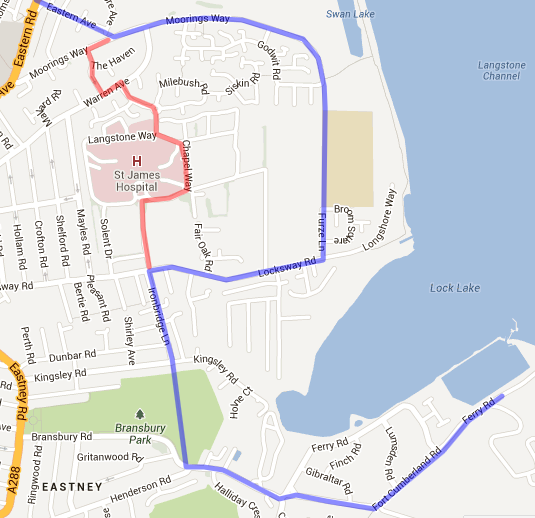
The first part of the route simply retraces my steps, along 20mph roads to Bransbury Park.  Then a short stretch of shared cycle/footpath across the park, back onto another 20mph street.  Here, unfortunately, I got a little lost, as I didn’t have a map with me. 


The route I had intended to take through St James Hospital (Jimmy’s, of television fame) is shown in red.  My actual route, in blue, takes something of a detour.  Without a map, and with basically nil in the way of signage, the sight which confronted me here threw me off the scent – I just assumed that the entrance to the hospital might be the only one, with no exit on the opposite side.


As it is, I am not sure the distance is really all that much shorter, and the route I took was by no means unpleasant, through part of the Portsmouth University campus, along a bus & bicycle-only road here.

View Larger Map


Finally, out of the warren of residential streets, I emerge on to the Eastern Road – one of the principal routes into Portsmouth and Southsea and a busy dual-carriageway for much of its length, although again it is notable how sedate Pompey motorists tend to be. Much of this road has a 50mph limit but the traffic tends to move closer to 40 – the sequence of the traffic lights renders it futile to travel faster and the locals seem to have “got” that.


There is a shared-use foot and cycle path which runs the length of this road on the eastern side.  It is not exactly of premium quality, but serviceable for the volume of traffic it carries.  Shared use of course is never ideal, but the nature of this route is that very few pedestrians would want to use it so cyclists can proceed largely unhindered and without conflict.
 
Just here the path is separated from the road - mainly it is right next to it and just separated by kerb

Finally, duty done, time to head home.  I can pick up a London-bound train at Hilsea – only stopping services stop here, but the journey time back to Haslemere is still only about 45 minutes and adding for the rides at either end of the train journey, it is still only a little over an hour, compared with about 45 minutes by car.   For one person, a day-return ticket is slightly cheaper than the petrol burn, and in any case I have a stack of freebies which come with an annual season ticket over the years.

For this I would normally use my Brompton - in principle, on a weekend it should be possible to take my Fahrrad Manufaktur on the train but I prefer not to risk an hour's wait for the next train because the cycle storage area is already full, and South West Trains does not restrict folders.


The ride to Hilsea Station is so-so – a 30mph road but local custom (not legal as far as I can tell) is to treat the footpath alongside as shared use, and the final stretch is a proper cycle path which avoids the railway road-bridge.  There is, however, this:
 

Alternative DfT might like to add this to his collection of football-pitch-sized junctions!


When the lights go green, it is not for long so you have to accelerate sharply and, going straight ahead across the junction, you have to  weave around the cars coming the opposite way and turning across your path.  There are no pedestrian crossings here either.


Now, Portsmouth is by UK standards a cycle-friendly city.  It was one of the first to introduce a city-wide 20mph limit on all residential streets, and although average speeds have not subsided below 20 they have come down.  There is a network of off-road cycle paths, mainly shared use.  The 2012 Census shows Portsmouth as one of the top areas in England & Wales for cycling modal share on commuter journeys.  The City Council estimates that 70% of its children walk to school.


Cycling as %age of all residents.  If you exclude the >30% who work at home, or don't work, the dominant %age of all
travelling to work is ~7.5-15%

I suspect also that Portsmouth’s general cycle modal share – outside of commuter hours – bears a rather more favourable comparison to the census results than most places, where cyclists only appear for a couple of hours each weekday morning and evening.  Certainly most of my trips here are at weekends, and I see quite a few cyclists with Tesco bags on their handlebars, or just going about their business.

Although I am sure that to some extent policy plays a part in Portsmouth’s cycling modal share, I should think geographical and historical factors are predominant.  On geography, this is a flat landscape, and a compact area – a statement which might annoy some bloggers but it is true.  It is easy to cycle, and the distances are ideal for cycling.  (Even in the leading cycling nations such as the Netherlands, there is a steep transition from two wheels to four beyond a certain distance, indeed in the UK the mode shift against distance is much more gradual, albeit from a much lower base). The climate is mild and relatively dry.   It is also very densely populated.  Portsmouth is a labyrinth of Victorian/Edwardian “artisan terraces” where one car per household can just about be accommodated at the expense of having only one vehicle width available to drive along.  In most households that means one member can’t drive to work.  Historically, the city grew largely to serve the Naval dockyards.  These were built at a time when an employer would never have considered the need to provide car parking for his workforce, and much of the central city is a conservation area.  The dockyards in particular, like others around the country, were notable for cycle commuting.  I recall as a child watching the dockyard disgorge literally thousands of workers at the end of the day, all furiously pedalling their Raleighs homeward.

Even today, while perhaps 10% or so overall cycle to work, car commuters are less numerous than elsewhere.  Looking at the Guardian’s census map you can see that, while unquestionably a lot more than cycling, the numbers driving themselves to work are generally lower than average, especially in the south and west of the city, and the numbers being driven as passengers, while still miserably low, are rather higher than average, suggesting more car sharing.  Those walking to work, especially in the south-west of the city, are considerably higher than the national average.

Policy-wise, Portsmouth is doing a lot which is good.  It now has a signed 20 mph limit across all streets apart from A and B routes, with many streets having traffic calming as well.  On the faster roads, the traffic lights seem to be phased so as to discourage traffic from moving at the permitted maximum, and Portsmouth drivers seem to have taken on board the message that it is better to adapt your speed to the rhythm of the lights than to drag-race from one red light to the next.  Many of the residential streets are one-way, but quite a few – nowhere enough in my view – permit cycle contraflow. The city publishes a Cycling/walking map, showing recommended routes on quet roads and off-road paths, but sadly the signage on the ground doesn't live up to the promise of the map.
 

Specific cycle infrastructure can best be described as of fair-to-mediocre quality.  For typical UK cycle facilities that is praise indeed.


Tuesday, 18 June 2013

Less of the "driverless car" please!


There is a fashion at the moment on Twitter to mock media reports about traffic incidents involving cars, which appear from the reports to be driverless.

Now, I am going to use the terms “collide” and “collision” here, although I hate them – they are utterly inappropriate in this context.  They imply a parity between the colliding objects, in mass or momentum, which simply is not there.  Cars and Lorries do not “collide with” cyclists or pedestrians:  they run them down, or – very rarely – a cyclist runs smack into a stationary car or lorry.  It is just that it is simpler to use the word.

My first point is a pedantic one, about accuracy.  When a cyclist “collides” with a motor vehicle or vice versa, it is, indeed, the vehicle (s)he collides with.  The car may have a driver but  (s)he is safely ensconced within a safety cage of steel and glass, and at no point comes into physical contact with the cyclist who, being wrapped around their vehicle, is indeed the colliding object.  In that respect I think that the media reports are actually correct.

Secondly, I fear that in critiquing the journalism this emphasis on the driver as opposed to the vehicle driven does us no favours at all.  It is not – yet – a slogan of the pro-car lobby in this country, but a parallel can be drawn with the national Rifle Association of the USA which frequently parrots the nostrum “People kill people, guns don’t kill people”.  That is sophistry – true, but it entirely misses the point that without easy access to firearms it would not be possible to murder so easily, or to massacre on the scale seen at Columbine or Sandy Hook, and there would be no accidental gunshot deaths – possibly the largest single cause of homicides in the US, notably among small children.

Similarly, motor vehicles are what makes it possible for people in the UK to kill other people on such a scale.  Not through out-and-out criminality, but through inattention, negligence, recklessness, or aggression without proper thought to the potential consequences.  While it is undoubtedly true that we are far too lenient on motorists’ failures to show a duty of care to those around them, a far more effective way of managing the problem, in effect saving people from themselves, would be the Dutch way – keep motorised and non-motorised road users apart where possible, and where not, tame motor traffic or confine it to through routes and restrict it elsewhere to access-only.

Monday, 17 June 2013

And pigs might fly


This is the intro page to the new Mayor’s publication “The Embankments”.


Well, not exactly.  I had a bit of fun with this and switched references to Bertrand Delanoë ,  Paris, the Seine, and famous riverside landmarks there for references to Boris Johnson, London and the Thames.  The real thing can be found here. (Perversely, the filename suggests that the document is in Spanish, but do persevere.)

It could work equally well, couldn’t it?

Of course, you would need to set aside some space for a landing strip for all those aviating porcines which such a world would no doubt see.