Friday, 26 September 2014

A letter to my member of parliament


To: Rt Hon Jeremy Hunt MP

Dear Mr Hunt

I am writing to you as my constituency MP to protest at the misuse of grant funds by the New Forest National parks Authority (NFNPA).  You might ask what this has to do with your constituents, but please bear with me:  firstly, as the name implies, a National Park is a national asset, administered for the benefit of the national citizenry, and supported by grants paid for by the same.  And that includes your constituents.  Secondly, some of the grants available to the NFNPA, notably the Local Sustainable Transport Fund (LSTF) are combined with the South Downs National Park (SDNP) as the “Two Parks LSTF”.  The SNDP directly borders your constituency, and is extensively used and enjoyed by your constituents.  Funds awarded out of the Two Parks LSTF to the NFNPA are by definition therefore not available to be awarded to and spent by the SDNPA, and a misuse of funds by the one adversely impacts the other.

The NFNPA applied for, and was awarded, a significant sum, in excess of £2 million, to develop what would probably be the first example of a “Boris-Bike” style cycle hire facility outside a major city.  The cycles would be available for short term hires and could be collected from one docking station and delivered to another, with docking stations next to railways stations and in towns and villages and other points of interest in the South East of the Forest.  The scheme was conceived to be of benefit both to residents, and to visitors to the forest, and to provide an alternative to motor transport which, as I am sure you know, is frequently gridlocked around the forest, especially in summer.

The scheme was abandoned, due – according to the NFNPA – to the hostility of local residents.  The authority has produced no evidence of this hostility, indeed if anything the evidence suggests the reverse, but I’ll return to that.  Now, they wish still to keep the money that they do not propose to use for the applied-for purpose, and use it for other schemes.

If these schemes were in a similar spirit of sustainable transport and in particular cycling facilities, I would have no objection, but they are not.  The largest part of the grant would now, if they get their way, be used to resurface the edges of Rhinefield Drive.  The damage requiring this repair was caused by motor vehicles.  By the NFNPA’s own admission, only 139 cyclists a day use this road, and 1,562 cars drive on it daily.  (Source:  NFNPA http://www.newforestnpa.gov.uk/download/meetings/id/3393/nfnpa_nffce_programme_update_to_members_sept_2014 )  Clearly the beneficiary of this proposed expenditure, which should come from the road maintenance budget, will be the motorists, which does not fit with the sustainability objective.

Another significant chunk of the grant money is proposed to be used to upgrade cycle routes in the Moors Valley Country Park, a privately-run commercial concern some four miles outside the boundaries of the New Forest national park, largely accessible only by private cars.  This clearly goes against the stated objectives of the grant which are to promote cycling in the National park.

These proposals would replace the original proposal for a cycle hire system for which I understand that a contractor had been engaged to manage the service, apparently on the basis of hostility from local residents.  The NFNPA undertook an online survey, which was responded to by several hundred people, mainly residents of the Forest but also some visitors.  The responses to this survey were analysed in a report to the NFNPA. (Source:  http://www.newforestnpa.gov.uk/downloads/file/839/community_feedback_report_summary  )  Far from indicating significant hostility to the proposals, the survey responses as analysed showed something between indifference and mild tolerance for the proposals and for cyclists in general.  The supposed wishes of the residents not to have this scheme (even if it was only their decision to make, which it is not) are therefore mere assertions, not supported, indeed contradicted, by evidence.

So, to conclude, I would be grateful if you could express your constituents’ views to prevent this abuse of sustainable transport grant funding by the NFNPA.

Yours,

Saturday, 20 September 2014

Pushing water uphill, or building a cycle superhighway


We had our department Off-site last week.  After the obligatory morning session on “Strategy” (yawn) we repaired to the Lee Valley White Water Centre, at Waltham Cross, for a barbecue and team-building activities.

LVWWC was built for the 2012 Olympics and is now open to clubs and the public for white-water kayaking and rafting.  In essence it is simply a humungous swimming pool, in which water is pumped by tremendously high-volume pumps into a high-level pool, from where it cascades down a long winding channel into a low level pool, from which you ride back up, in your raft, to the high level pool on a kind of travelator, and start the descent all over again.  The channel is set with all sorts of soft-ish plastic blocks to create the effect of river rapids and white water.  Provided you follow the advice and ensure that, if you fall in, you float on your back with your feet facing downstream, you won’t come to any harm, and you’ll be swept by the current towards sets of steps where the monitoring staff will fish you out again.

Most of us opted for white water rafting, while some opted instead for a raft-building competition, using big plastic drums, poles and rope.  I can certainly recommend white-water rafting by the way, as a team building exercise.  It was also tremendous fun – as long as you (a) don’t mind the occasional swim, (b) are not of an excessively nervous disposition, and (c) aren’t self-conscious about being seen in a wet-suit.  (Only the positively anorexic could not look fat in a wetsuit.  I am sure the staff sized me up and picked the size with extra gussets).


Our group was 45 people, ranging in age from 23-year-old graduate recruits through to one 59-year-old senior partner, but in our pyramidal structure I would say that half were in their twenties and a third in their thirties.  There were 18 women, 27 men.  That is a fairly representative mix for a London Big Four accounting firm, or indeed most City institutions really.

12 of the ladies, and only one gent, opted for raft building, which was entirely dry – the rafts had to be tested in competition against each other at the end, but the wet-siders did that, one team of partners against another team of graduate recruits.  The partners won – not, I hasten to add, because the juniors thought it politic to let us win, rather because our raft, while appearing at first sight to be the flimsier, actually held together for the paddle out and around the green buoy and back, while the other team ended up swimming along pushing the pieces of theirs before them.

There was, apparently some grumbling about the choice of activity from the ladies.  Many did not want to get wet or have to get themselves together again in their finery for the evening’s entertainment, making cocktails at the Rebecca Hossack Gallery.  

This was evidently not a consideration which troubled the men.  It would be easy to fall into sexism here, so apologies if you think that is what I have done, but our female staff are generally more careful of their appearance, dress and grooming than our male.  I might add that it would be no bad thing if the men upped their game on grooming and dress – accountancy is still quite a traditional profession and clients tend to have more confidence in well turned-out staff.  It’s not that our men don’t wear suit and tie – they do – it’s just that they all too frequently look like they have slept in it.

Will I ever get to the point?  Well, looking around that 60/40 split of male and female staff, I recognised a sizeable number of men who come to work by bicycle.  Only one (plus one other who was on holiday at the time) do I know among the women who does the same.

I understand that one factor, if perhaps not the most significant, is the perception that cycling to work has an adverse impact on grooming and dress.  Having to change out of lycra, applying the slap in the ladies’ at work, and getting “helmet hair”.  As I say, not something which much troubles the men, although perhaps it should.

Is this a fair argument against cycling?  Who am I to say it is not?  In any case, it is not hard to see why people would think that, when they look at the cycling environment we face every day.  Probably a more pressing concern is that people (not just women) often don’t feel safe on the roads.  I know that the statistics suggest that this is not the case, that cycling is less dangerous than, say, tennis or golf, but that is not how it feels, especially when the strategy adopted by our government to encourage people to cycle, and to assure them that it is safe, is to say “wear a helmet and high vis”, and to push the Franklin tome on cycling - “Cyclecraft” - with its exhortations to keep safe by matching the speed of motor traffic, occupying the slap-bang centre of the traffic lane, and keeping a high cadence so that you can quickly achieve “sprint speed” at roundabouts.

But who says it has to be that way?  Can we not cycle in ordinary clothes, business attire even, if we ride the right type of bicycle?  Instead of getting up like a fluorescent canary and riding “choppers” (bikes cut down to the bare essentials, removing weight-adding stuff like fairings and mudguards), can’t we ride practical machines which protect our clothes, including, if you like, your Shalwar Kameez, as mentioned in that excellent feature in the Birmingham Post the other day?  Of course we can, but you would have to be super-fit to do that Franklin-style and not find your business suit wringing wet by the time you reach the office.  Most people would prefer to proceed rather more sedately, in gentlemanly or lady-like fashion.  For that, we need proper infrastructure.  Not blue paint or broken white lines, but concrete, kerbs and medians, and bollards and planters, to keep us apart from the danger which we either avoid altogether by not cycling, or adapt to by cycling like prats.

The Elephant-Kings Cross route at Ludgate Circus. That tree in the middle
is where I would get off, 100 yards from my office


In that Birmingham Post article, Councillor Deirdre Alden, who made the remarks which provoked this response, has clearly still not “got it”.  She still thinks cycling discriminates in favour of young white men.  She still confuses cause with effect.  I doubt she is by any means alone in having such misconceptions, so how to convince her, and her ilk?

All the more reason for pushing hard and fast for the Mayor of London’s proposals for a North-South and an East-West segregated cycle superhighway.  This is, you might say, the canary of mass, inclusive cycling, not just in London, but eventually around the country.  If it dies, it tells us that the mine is toxic to humans too.

Tuesday, 16 September 2014

A tragedy foretold


Firstly, I should declare an interest.  The incident I describe below occurred on an event organised and sponsored by the firm of which I am proud to identify myself as a partner.  This annual JoGLE/LEJoG event has about 800 participants, drawn from our partners and staff, clients and members of the general public who commit to raising sponsorship money for charities.

My senior partner, David Sproul, is a keen cyclist, who has participated in this event himself.  A significant number of his senior board-level colleagues are also keen cyclists.  About a dozen of our partners took part in the event this year, and many more of our staff – a certain number of the places are set aside for the firm’s partners and staff and they are always heavily over-subscribed, such that some staff get the opportunity to take part only by forming “relay teams” who share the riding each day.

My firm is committed to cycling in many other ways.  Our London offices have space for more than 600 cycles in secure parking – for a complement of about 7,000, many of whom spend weeks at a time working at client offices, so this represents in effect more than 10%, well above the new, and especially the old City of London planning standards for cycle parking.  With the parking comes lockers, showers, and even fresh towels for those willing to pay a nominal charge for them.

I talk about “describing” the incident but actually I can’t – the information so far in the media is sketchy.  We know that Sally Preece was involved in a collision with a “car” on the A82 somewhere near Loch Earn, but we don’t as yet know more about the circumstances – whether it was at a junction or not, for example.  (One of the comments on the road.cc article speculates on  sudden emergences of a car from a side road, or a cycle ditto, but in that respect the BBC website article could be misleading – it shows a google image of a junction on the road, but that may signify nothing more than where the road closure to deal with the incident was set up, after all a traffic diversion would require a junction to turn at). There will presumably be an inquest and that is the proper place to determine the facts.


A tragedy was in fact foretold, and perhaps it was inevitable, indeed it has been pointed out that statistically, there should have been one by 2012, so the inevitable  was delayed by two years.  Whatever the underlying reasons, the cause was interaction of a motor vehicle with a vulnerable road user.  (One might well question why the selfish pricks who form the “A82 Partnership” could not just accept that, for less than a half day in this year and possibly alternate years, the passage of 800 cyclists raising millions for charity might trump their selfish need-for-speed, but there you have it).

Now move south, to London, and the ongoing consultations on the East-West Cycle Superhighway, the so-called “Crossrail for Bikes”, and its North-South companion.  These proposals would not have helped Mrs Preece.  They are a matter of London government alone, and sadly there is so far not much sign of other metropolitan areas, or indeed counties, following suit.  However, the dangers cyclists face, in having to mix with fast-moving motor traffic on the roads, are very much the same.  It is my sense that my firm, while supportive of staff cycling, are concerned that they should not push them into doing anything which might put them in peril, so facilitation of cycling falls short of active encouragement.  The two new proposals would specifically address that concern in very large measure, especially as our offices are literally a hundred yards away, on a quiet cul-de-sac which is permeable to bicycles, from the North-South route, and less than a quarter-mile from the junction of the two routes at Blackfriars.  Staff could travel to work from four points of the compass in comfort and safety, and arrive at their desks with the fitness, alertness and vitality that the firm knows comes with active travel to work.


In contrast to the generally welcoming response from cyclists, academics, some NHS bodies and a so-far small group of contrarian businesses, we see an overtly hostile reaction from the City Corporation and from  London First, a membership organisation which purports to speak out for London businesses.  Don’t be fooled by the terminology – anyone who talks about “balancing the needs of all road users” is in practice arguing for the hegemony of the motor vehicle, as has been seen countless times over the last many years.


"benefit all road users" - that tired old canard again

Now, London First purports to represent the interests of its paid-up members but the distinct impression I have gained is that they did not consult any of their members before they launched their offensive against the proposals.  Certainly I don’t have the impression that my firm, with its generally supportive policy on cycling both as sport and as commuter transport, and its Corporate Social Responsibility policy which includes commitments to minimise travel by car or taxi, was canvassed for its opinion in advance.

I am only one of over 700 partners, so I have no authority to speak on behalf of the firm.  Our corporate position will of course take into consideration a whole host of commercial considerations as well as our CSR policy, HR policy, and the interests of the clients we advise.  I think – I hope – that none of this prevents them from coming out firmly in favour of the proposals now.  I know that I am not alone in this.

Update:  in one of those serendipitous events, the Evening Standard has reported on a statement of the bleedin' obvious - most London workers can't find time in their busy lives for proper exercise, but they could sort it out with active travel to work.  The superhighways are just what the doctor ordered.

Friday, 29 August 2014

Montreal


I had the opportunity for a few days in Montreal, seeing my daughter off on her new adventure as an university student there, so I had a bit of an explore to see how claims made on behalf of the city to be North America’s most cycle-friendly city stand up to scrutiny.

I should firstly say that  I have only visited four  US cities, none of them particularly recently – I suppose it is just that I don’t really view the solution to the USA’s major problem with firearms deaths being yet more guns as an inviting or welcoming message, especially after the most recent fiasco – and Portland is not one of them.  So I have little to go on in assessing Montreal’s American credentials.  These are just some anecdotal impressions.

Modal share & culture

The city’s cycling modal share doesn’t actually strike me as all that impressive.  This visit was last weekend, ie end of August, so it is in the summer – important because evidently winter conditions make cycling distinctly unattractive – but just prior to the mass return of university students for the start of the Fall Semester on 3rd September.  Possibly it improves next week.  Comparing central Montreal (Downtown, Vieux Port, Latin Quarter) with an equivalent part of London I would say the mode share is really quite low, although it does seem to be more consistent throughout the day, ie probably more routine utility journeys if fewer commutes.  The better infrastructure is definitely busier than the lower-quality or no-infrastructure streets around it – no shit, Sherlock – but even top facilities like the MaisonNeuve segregated path seem to carry fewer cyclists than an equivalent, though inferior, facility in Torrington place etc in Camden.  Others have commented that Montreal’s reputation for cycling might rest on the Plateau Mont Royal quarter, which is just to the west of McGill University where we were staying.  The Plateau resembles Hackney, in more ways than one, but even here I wouldn’t say that modal share was at Hackney levels.

The great majority of private bikes that I saw were low-budget models, ranging from complete junkheaps through to the lower-middle of the Halfords range in quality.  This may reflect the user population – I recall in my student days that few of us had expensive bikes if only for the risk of them being “borrowed” by students anxious to make their next lecture on time.  Certainly I don’t think I saw a single Pinarello, or indeed a Pashley, or any brand of Dutch bike, most models being derailleur-geared hybrids, without lights, mudguards or panniers.  Hub gears seemed to be non-existent, which surprised me considering the unquestionable superiority of the hub for stop-start conditions with frequent traffic lights – and almost no red-light-jumping whatsoever – and lack of maintenance requirements.  I similarly saw very few decent locks, or much evidence of savviness in locking a bike securely, to a decent parking facility – of which more below.

The vast majority of people I saw on their own bikes were conventionally dressed – shorts and tees, summer dresses etc – with almost nil evidence of lycra.  Similarly, few helmets and then mainly of the urban Bern styles rather than chiselled-whippet Giros. This was even more the case with the Bixi hire-bikes, as you might expect.

Cycling etiquette was pretty good.  It was hot, this was not London or New York, and the European influence (French almost universally spoken around you) was evident, but people generally rode at a fairly sedate pace, and I almost never witnessed anyone jump a red light.  In fact, it did seem to me that Montreal showed that it is quite possible for all road users to behave quite courteously and sensibly towards each other – not that this would justify not providing the right infrastructure – and obey the law.  Sure, cars occasionally amber-gamble, but I never saw one pass a light at red, bar one case I saw on a bus tour, which the tour guide put down to the fact that the car had US plates, and the driver might not have been aware that the common US concession to turn right at a red light does not apply in Montreal.  In general where vehicles were turning right at lights, the implication would be that the cross-traffic was held at red and pedestrians would have a walking-man.  Unlike London, where motorists would simply hoot and bully the pedestrians to hurry up and get the f*ck out of the way, motorists simply waited patiently until pedestrians had crossed.  Perhaps that goes some way to explaining why traffic congestion there is what it is – not many cars get to make a right turn on any one green light.  Pedestrians, too, stuck to the rules, often to the point of absurdity, waiting patiently on an empty street while the lights changed.

Cycle paths, cycle lanes

Much of Montreal’s positive reputation rests on schemes such as the Boulevard de MaisonNeuve cycle path, image below. (I have used embedded Streetviews, for interactive viewing): 
 

View Larger Map


This runs along several miles of one of the principal downtown thoroughfares (thought of in Montreal terms as being east-west, although in reality it runs a lot closer to north-south).  It is similar in a way to the Torrington Place path in Camden, only a lot longer and also quite a decent width.  Also, encouragingly, not only is it largely immune to illegal parking blockages, as it is protected by quite a high kerb and median, during our stay it was closed in places to accommodate builders’ machinery, but in compensation a motor traffic lane had been coned off and provided exclusively for cyclists’ use.

The curse of the UK cycle path, the give-way to side streets, doesn’t appear to be an issue here, although that may simply be because, in the north American grid system, virtually every junction is a cross-roads, and they are all light-controlled anyway.

MaisonNeuve has an interesting history, related here:  the local government’s strategy to gain buy-in for the project, which would entail the loss of on-street car parking spaces, was to focus not on the number of spaces to be lost, but on the proportion of all available spaces within two blocks (about 5 minutes’ walk) which would be lost – about 3%.

There are a few other instances of similar paths, such as this, in University Street, which heads “north-south” in Montreal-speak.


View Larger Map


This one starts on the corner with MaisonNeuve, and ends at the entrance to the McGill Campus about 600 metres away.


Beyond this, the on-street infrastructure isn’t really much to write home about.  Lots of paint on the tarmac, slightly better respected by motorists than their UK equivalents, but that is all.  Some examples seem quite perverse.  Take Prince Arthur Street “West”, for example:  here you can see a quiet, largely residential street, lightly used and with a 30kph speed limit, one-way but well wide enough to accommodate a cycle contraflow.  So what do they do?  They paint a useless pair of solid white lines for cyclists to follow, in the permitted one-way direction, in the dooring zone, that is all.


View Larger Map


(As an aside, we stayed during our visit at the University B&B, which is visible to the left of frame in the shade of that tree.  I can recommend it – clean, comfortable, unpretentious and by Montreal standards reasonably priced.  They have a website if you are interested)


Or take a look at this parallel road, Milton Street.  Here the cycle lane is more sensibly a contraflow, although the road environment is no better or worse than in Prince Arthur St.  You can see in the Google image that the paint would be precious little use to protect an oncoming cyclist, and that is exactly what I saw more than once during our stay.  I suppose judging by general behaviour  motorists would not stray across the line if a cyclist was actually coming the other way, and at least the dooring zone faces the parked motorists so they can see you coming,  but it is hardly perfect.

View Larger Map


These two streets are right on the “western” edge of Plateau Mont Royal, the largely flat area beside the steeply sloping Parc Mont Royal.  The quarter proper starts at Avenue du Parc – not an attractive proposition for a cyclist but the grid of streets behind it is rather reminiscent of Hackney, in more ways than one.  More cyclists, more facilities for cyclists such as parking stands, more “hip”, a slightly down-at-heel area which nevertheless is popular with younger middle class folks, and has attracted a wide variety of independent shops and cafes.  Like Hackney, its attraction as a cycling area has little to do with specific infrastructure, relying instead on traffic calming and permeability measures.  It is popular with McGill students, as it is a short, flat walk from the campus, and that is extremely important in winter, when snowfalls are heavy and daytime temperatures can be low enough for the local met office to advise people to spend no more than 5-10 minutes out of doors.  One of our last purchases for my daughter before heading home was a “Canada Goose” down jacket with fur hood, and Sobel snow boots.  Watching anyone cycling in such garb would be an amusing sight – Michelin Man on a bicycle.

Cycle parking

Provision for securing your bicycle on the street in most of Montreal is either non-existent, or extremely subtle.  There are some posts with small horizontal rings encircling them which appear to be intended to function like the CycleHoops we see clamped to lamp posts and street signs in parts of London.  For the most part people rely on the forest of signposts which seem to clutter sidewalks in any north American street.  This works, after a fashion, but it clearly doesn’t allow for the conflicts it can create between the bicycle and the ease or convenience of passing pedestrians or, indeed, parking motorists.


The position is much better in the Plateau area, although even there the facilities are inferior even to a typical London “Sheffield Stand”.  It is not just that north American cities don’t pursue the same aesthetic standards as, say, the City of London does – that is true about almost every aspect of the urban realm – but also the available stands don’t appear to be very securely fastened to the ground, or conducive to good cycle locking practices (around the frame and both wheels, through a closed loop on the stand).  Mind you, as the photo above suggests, owners might not regard their bikes as worth very much effort to protect, the quality and the condition most of them are in.


View Larger Map
Yes, this is a bike stand

Cycle hire

Montreal strikes me as an ideal city for tourists and visitors to get about by bicycle.  Unfortunately, Mrs M falls into that category of nervous cyclists for whom segregation is a sine qua non, so we wore out a lot of shoe leather and got blisters from all the walking we did, but where there is no protected infrastructure, I would say the road environment and driver behaviour  is civilised enough for most able-bodied adults.  The terrain is reasonably flat, and the distances manageable – if you think of central London as being bounded by the river, Euston Road, Kensington Church Street and Bank, the equivalent area of Montreal is only about half the dimensions of London.  Distances are increased if you want to progress diagonally as, like any American city designed on a grid system, that requires you to “tack” repeatedly to left and right of your desire line.  You also have to deal with the general lack of cycle contraflow on the one-way streets which make up a significant proportion of downtown.

The road surfaces are also pretty terrible.  I didn’t see any potholes, but subsidence and heave, and cracking of the surfaces, are rife.  This is probably inevitable, and not worth the cost of fighting, where winter temperatures can stay below -20C for days on end and metres of snow can be dumped in a single day.  It does however make for a pretty bum-numbing ride.  I had thought to lend my spare Brompton to my daughter to use there, but I doubt she would tolerate the bruising for long.
 
So, they have Bixi.
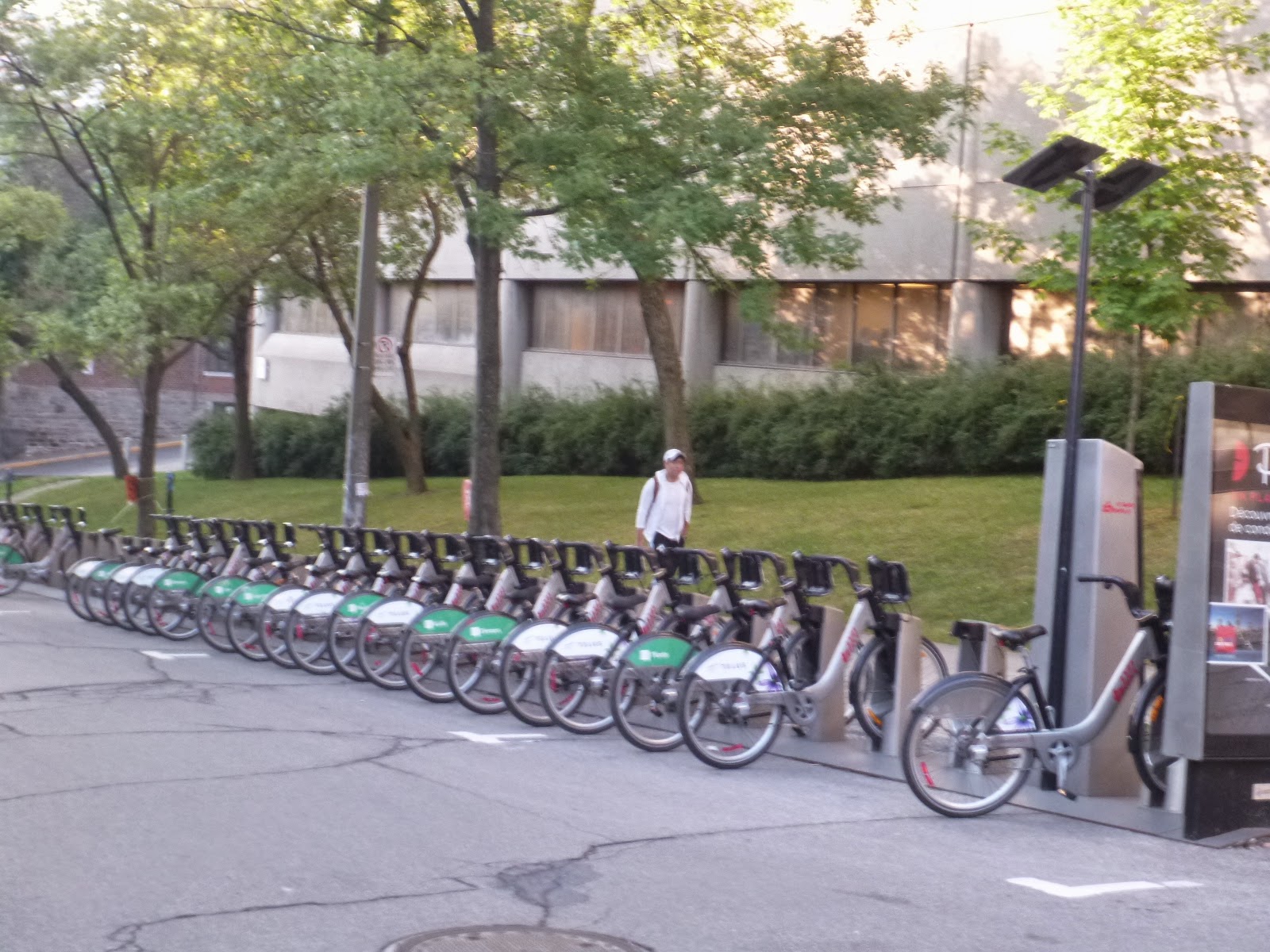
Bixi hire bike docking station outside McGill Campus on Rue University
If they look familiar, it is because they are:  they are just like the London cycle hire scheme (or rather, vice versa, as Bixi came first and both schemes are made by a Montreal company).  Except of course that Bixi doesn’t give free advertising to Barclays Bank.
 
I hadn’t ridden one of these before – no need back home as I have my Brompton – and I must say the experience was, well, interesting.  It rather felt like the effort required to be input, and resulting output, were comparable to riding a pedalo on the Serpentine.  The bikes also made all sorts of alarming clicking, whining and scraping noises, which would have worried me deeply had I not known that I could return it to a dock and forget about it at  my leisure.  But it was fairly comfortable, and rode through the awful road surfaces with less bruising and battering than I might have suffered on skimpier tyres.
 
The scheme is only open about seven months a year, with the stations being progressively stocked during April, and destocked during November.  Evidently cycling largely stops in mid winter, no doubt due to the abundance of snow and ice everywhere, and the difficulties in riding around dressed like Michelin Man in wellies.  Residents can buy an “annual” subscription for C$82 (£47) or  28 day pass for C$28.  For visitors, the scheme seems quite dear, at C$7 (£4) for 24 hours – twice the price of the London scheme – or C$15 for 72 hours.  For any combination of 1-7 days, whether buying a 24 hour pass or a 72 hour (in London 1 week) pass, the Montreal scheme would cost between 45% and 100% more than in London.  Considering that the general exchange rate for retail prices on coffee, meals etc  in Montreal is C$1 buys £1, ie 40% cheaper, this reversal is remarkable.  Otherwise, the conditions of use, first 30 minutes free etc, are substantially the same.


I figure I am going to be here a couple of visits a year for the next three years, so I imagine I’ll get plenty of chance to explore.

Tuesday, 28 January 2014

Infamy, infamy, they've all got in for me!


This article featured in yesterday’s “Times”, penned by transport correspondent Philip Pank


True, the impression conveyed by these opening paragraphs is not borne out by the remainder of the article, where more statistics are referred to, but that first paragraph is not merely misleading, it is mendacious.  Poor old Kaya Burgess, by all accounts a good man and a friend to cyclists, really got it in the neck on the Twittersphere yesterday although he neither wrote the offending piece, nor had any influence in the editorial decision to run it.  That seems unfair, (although I guess no more unfair than the abuse many platform attendants and ticket inspectors get from rail passengers over the SNAFUs generated by the incompetence or greediness, or both, of their privatised rail company bosses. )

It says “motor vehicles kill five times more pedestrians than cyclists”.  Firstly, to be pedantic, it is drivers of motor vehicles who kill pedestrians:  to quote the NRA mantra from the USA “guns don’t kill people, people kill people”.  Here the wording depersonalises the offences of motorists but leaves cyclists, as people, fully open to personal opprobrium.  More importantly, to be truthful the statement should read “motor vehicles kill one hundred and forty four times more pedestrians than cyclists” (because the ratio revealed further down the article is 145:1).

The claim actually made is based on a per-mile basis of comparison:

Cyclists killed 0.27 pedestrians per billion km pedalled, compared with 1.4 pedestrians killed per billion km driven in 2012, the latest year for which figures exist

Note that this comparison is for a single year.  I have no idea whether the comparison would be more or less favourable to cyclists if, like the other stats the Times quotes, they had compared over the decade to 2012.  In any case, while it is obvious that motorists cover far more distance per annum than cyclists, and it is arguably reasonable to factor distance into the equation, in my view the comparison here is false.  The distance numbers exclude, for both cyclists and motorists, roads which are not “urban non-motorway”

Up to a point, that is a reasonable exclusion.  Neither cyclists nor pedestrians are permitted on motorways, and neither is likely to be seen in any significant numbers on non-urban trunk routes.  In fact the same is true of non-urban routes generally, as the distance penalty against pedestrians and cyclists is far greater and - counter-intuitive as it might seem - rural roads are far more dangerous for cyclists and pedestrians than urban streets.

But it goes further.  Quite significant stretches of urban non-motorway will also present almost negligible numbers of pedestrians and cyclists.  Have you ever seen a pedestrian or cyclist on, for example, the A3 between Tolworth and Wandsworth West Hill?  Or on the North Circular Road?  The urban A1?  The A2?  The Westway?  These are all urban and they are none of them motorway. 

And then what about central London roads such as Upper and Lower Thames Street?  These roads have far greater traffic densities, ie vehicle-kilometres/day per road kilometre, than most of the roads where cyclists and pedestrians are likely to be sighted.  If you were able to make a comparison of the KSIs per vehicle kilometre travelled on roads where cyclists and/or pedestrians are actually found, rather than on all urban non-motorway, I am absolutely sure the ratios would diverge significantly.

Furthermore, The Times states that for each vehicle mile the casualty toll (killed or seriously injured) from motorists and cyclists are broadly similar, but  in the spirit of the famous Mark Twain quote that there are three kinds of lie:  lies, damned lies and statistics, as road.cc observes, you could measure the casualties by reference to the distances travelled not by the vehicles, but by the pedestrians themselves.  On that measure for every kilometre walked by a pedestrian, he or she is sixty times as likely to be killed or seriously injured by a motorist as by a cyclist.

Finally, less of a numerical comparison:  what exactly does “seriously injured” mean?  As I understand it, all cases referred for hospital treatment are classified as seriously injured, but that covers an enormous range.  At one extreme it could mean life-changing brain damage, spinal damage leading to paraplegia or worse, or loss of one or more limbs.  At the other, it could mean a few stitches, or a broken wrist – not to be dismissed, but recoverable.  I have no information on this – I don’t even know whether any is actually compiled – but I would wager that most injuries incurred in a cyclist-pedestrian incident fall at the “best” end of the range, while contact with a 1.5 tonne metal box travelling at 30mph or more leads to a significant number of injuries at the worst end of the range.

So, why does a responsible, quality newspaper write this mendacious crap?   What point are they trying to make?  If it was somehow meant to be supportive of cyclists or pedestrians, when you read most of the on-line reader comments, do you think they were successful?  No?  Or are they descending to the Daily Mail "sidebar of shame" clickbait to provoke outrage and generate on-line advertising revenues?

Tuesday, 31 December 2013

I have to smile


I was prompted to write this post by something I tweeted on Twitter a couple of days ago, which has generated far more responses, retweets and favourites than anything I have previously tweeted.


Clearly it struck a chord – or hit a nerve, depending on your point of view.
 
By way of background, I live in the area administered by Waverley Borough Council, a semi-rural location tucked into the south west corner of Surrey, bordering West Sussex and Hampshire, largely overlapping the parliamentary constituency of our Health Secretary Jeremy Hunt.  It comprises several villages and four small towns:  Cranleigh, Farnham, Godalming and Haslemere.  It is prosperous, having not so long ago won the accolade of the borough with the best quality of life in the whole of the UK, and having, at the last census, 87% of households having the use of at least one car. *
 
Just as a convenient index of poverty and deprivation in a community can be made from the proportion of children eligible for free school meals, for affluence you could have the “Waitrose Index”, and on that index Waverley scores highly with a near maximum score of 3 – only one of the four small towns does not have a Waitrose branch.
 
Two of the three branches do not have their own car parks, relying instead on adjacent Borough car parks, for which a charge is made – 80p for the first hour and £1 for each subsequent hour.  (Not, in my view, a sum which would genuinely motivate a typical local Range Rover driver to travel to BlueWater).  So, to attract business, Waitrose offers a refund of 60p against the counterfoil on customers’ car park tickets when produced at the till, where the total exceeds £10.
 
I don’t deal with the household’s main weekly shopping needs – that falls to Mrs M – but I typically go down of a weekend for a top-up of things like milk, fresh fruit and veg, and quite often a Sunday roast.  For convenience I use the self-scanners.  The system can’t verify your car park ticket stub to authorise the refund but is clearly configured to assume that you must have one, so as I almost invariably spend more than £10 on a visit (hard not to, in Waitrose, even with only a bicycle basket) I get the refund automatically.
 
Personally I think that is sending the wrong signal to customers, but it is probably a sensible commercial decision for Waitrose to take in such a car-dependent area, and here’s the thing:  those car parks get very crowded indeed at peak times.  Sometimes you can watch the bankers’ wives in their Range Rovers, roving the car parks ready to pounce on the first  space to come free – and to exercise pretty sharp elbows when two 4x4s converge on the same space at the same time.  Would it  not make commercial sense to incentivise customers who have arrived on foot or bicycle, to ease the pressure on the car parks and so make more spaces for more customers?  Should they not extend the car park refund without conditions, or even go a step further and offer a larger discount to people who can show they have not driven to the store?  The third store (Godalming) having its own free parking does not offer this refund, so couldn’t something which is not offered at all to drivers be offered there to non-drivers?
 
Of course, proving it might be tricky, as negatives are always harder to prove, but perhaps if they provided a rack of cycle locking points, ready fitted with locks and keys?  A bit like the lockers in gym changing rooms, where you take the key with you on a wristband after you’ve locked up your outdoor stuff but the key can’t be removed from the lock unless it is locked closed.  Or the facilities for storing your skis at the bottom of a ski lift in a typical alpine resort?  You would then simply produce the key at the till for your rebate.
 
 
Come on Waitrose (and Sainsburys, Tesco, Asda and Morrisons) - what's stopping you?
 
* It is also a fantastic area for off-road cycling, with conditions to satisfy and challenge almost all skill levels.  Do come and try it out.  Or if you are roadie, try the “Little Lumpy” sportive at the end of May.

Sunday, 29 December 2013

Out of town, or out to lunch?


I was reading a Twitter conversation yesterday, a series of exchanges between a lady called Frances Coppola (I assume no relation to Francis Ford Coppola, the film director, but you never know) and various tweeps with a cycling frame of mind.

Ms Coppola is no doubt a thoughtful and amusing person in many respects but I thought her observations on out-of-town shopping centres vs traditional town centres were just plain silly.  Here is a taste:


Elsewhere in her timeline she comments that people like shpopping malls because they are “easy” to  park.

Easy?  Thinking about the two Westfields – Stratford and Shepherds’ Bush – and Bluewater, what springs to mind is either basement carparks under the buildings or vast flat sheets of tarmac outside.  The former are deeply uninviting places – dark and under-lit, with loads of blind corners and pillars for muggers – real or imagined/feared – to hid behind.  They are also huge, and confusing.  You could easily get lost in them, or at least have difficulty in returing to your car unless you have left a breadcrumb trail to follow back.  Unless you are an early-bird, chances are you will have to park at some distance to the pedestrian exit and access to the shops, because the early arrivals – human nature being what it is - will have snaffled all the spaces close to the exit.  You will in all probability have a longer walk from car to shops than you would have to suffer in your local town centre.

And in the  open-air examples, you may not have the fear of footpads, but you still have the confusion about where you parked you car – ever parked in Gatwick South long-stay? – the long walk to and fro, plus exposure to the elements, is no better than in your town centre.

And parking is not the only issue, as this tweet from TfLtrafficnews shows us:


No, people don’t go to Westfield because it is easy to park, or if they do, they have a screw loose.  All that is easy about it is that you will likely not be disappointed about finding a space – somewhere.  The lady referred to last year in one of Mark Treasure’s Aseasyasriding blog posts, writing to the local paper in Horsham complaining about the £1.20 per hour parking charges there, which motivated her to drive to BlueWater – a round trip of a good 100 miles and thus probably nearly ten litres of petrol at a cost of about £13 – may have been miffed about having to pay for parking, but that cannot have been her true motivation for going to BlueWater.
 
As that loyal hound of the Founder, Spokesman and only member of “Drivers Union” succinctly tweets:
 
People go to shopping malls (out of town or in town) not because of the ease of parking, or at least only partly so.  They go because the shops they want are there – mainly multiples because independent retailers could never afford the rents – and the shops they want are there because the developer has created an environment which customers want to be in and so attracts business.  That environment is frequently sheltered from weather, and it is clean and fairly secure thanks to an army of private security personnel, but mostly it is entirely pedestrian – you may have to drive some distance and for some extended time on congested streets but once you are there, it is traffic-free.  Far too few town centres are that lucky.  Mine certainly isn’t.